 Add to Chrome
 Add to Firefox
 Add to Edge
COLLIE: Guiding Skill Discovery in Semantically Coherent Latent Space
May 31, 2026
Unsupervised skill discovery (USD) aims to learn diverse behaviors without reward functions, but often results in task-irrelevant or hazardous behaviors due to uniform exploration. Guided skill discovery (GSD) addresses this issue by incorporating human intent to focus exploration on meaningful regions. However, existing GSD methods typically require training additional guidance models, and rely on pre-defined rules or expert demonstration, which can be ineffective under sparse, online-collected human feedback. To overcome this, we propose COLLIE, a GSD framework that leverages dense unsupervised data to construct a semantically coherent skill latent space. This latent space is well-structured, enabling reliable guidance with sparse online feedback. Moreover, its semantic coherence property enables training-free construction of guidance signals, eliminating the need for additional model training beyond skill learning. Theoretical analysis justifies the effectiveness of our training-free guidance signal, while experiments across diverse state-based and pixel-based tasks show that COLLIE learns diverse, human-aligned skills, avoids hazardous behaviors, and achieves superior downstream performance with minimal human feedback.

Curriculum reinforcement learning with measurable task representation learning
May 22, 2026In curriculum reinforcement learning (CRL), an agent incrementally accumulates knowledge over a sequence of tasks (i.e., a curriculum), and the learning process is aimed at using the accumulated knowledge to finally solve a challenging target task. While early CRL works focus on sequencing candidate tasks, recent research explores automatic curriculum generation. Among the rich CRL literature, the interpolation-based CRL paradigm is a main body, which automatically generates intermediate tasks by interpolating between the initial task distribution and the target task distribution in task space with meaningful distance metrics (i.e., can measure the task similarity). However, in challenging navigation tasks, the non-Euclidean context (task) space invalidates this assumption. To achieve automatic curriculum generation in complex task, we propose a novel automatic curriculum generation approach based on measurable task representation learning. To better measure the similarity, we propose to transform the task space to a latent space. Through a variational autoencoder structure that encodes the reward and the state transitions, we achieve a latent task representation with a task similarity measurement property, and two close task embeddings correspond to two similar tasks in terms of rewards and state transitions. Based on the learned task representation, we further develop an automatic curriculum generation scheme, which can effectively generate new tasks more and more similar to the target task. We evaluate our method in a variety of challenging navigation tasks, and the experiment results indicate that the proposed approach surpasses state-of-the-art CRL approaches based on interpolation and generative adversarial networks.
GlobeDiff: State Diffusion Process for Partial Observability in Multi-Agent Systems
Feb 17, 2026In the realm of multi-agent systems, the challenge of \emph{partial observability} is a critical barrier to effective coordination and decision-making. Existing approaches, such as belief state estimation and inter-agent communication, often fall short. Belief-based methods are limited by their focus on past experiences without fully leveraging global information, while communication methods often lack a robust model to effectively utilize the auxiliary information they provide. To solve this issue, we propose Global State Diffusion Algorithm~(GlobeDiff) to infer the global state based on the local observations. By formulating the state inference process as a multi-modal diffusion process, GlobeDiff overcomes ambiguities in state estimation while simultaneously inferring the global state with high fidelity. We prove that the estimation error of GlobeDiff under both unimodal and multi-modal distributions can be bounded. Extensive experimental results demonstrate that GlobeDiff achieves superior performance and is capable of accurately inferring the global state.
MrCoM: A Meta-Regularized World-Model Generalizing Across Multi-Scenarios
Nov 09, 2025Model-based reinforcement learning (MBRL) is a crucial approach to enhance the generalization capabilities and improve the sample efficiency of RL algorithms. However, current MBRL methods focus primarily on building world models for single tasks and rarely address generalization across different scenarios. Building on the insight that dynamics within the same simulation engine share inherent properties, we attempt to construct a unified world model capable of generalizing across different scenarios, named Meta-Regularized Contextual World-Model (MrCoM). This method first decomposes the latent state space into various components based on the dynamic characteristics, thereby enhancing the accuracy of world-model prediction. Further, MrCoM adopts meta-state regularization to extract unified representation of scenario-relevant information, and meta-value regularization to align world-model optimization with policy learning across diverse scenario objectives. We theoretically analyze the generalization error upper bound of MrCoM in multi-scenario settings. We systematically evaluate our algorithm's generalization ability across diverse scenarios, demonstrating significantly better performance than previous state-of-the-art methods.
SC2Arena and StarEvolve: Benchmark and Self-Improvement Framework for LLMs in Complex Decision-Making Tasks
Aug 14, 2025Evaluating large language models (LLMs) in complex decision-making is essential for advancing AI's ability for strategic planning and real-time adaptation. However, existing benchmarks for tasks like StarCraft II fail to capture the game's full complexity, such as its complete game context, diverse action spaces, and all playable races. To address this gap, we present SC2Arena, a benchmark that fully supports all playable races, low-level action spaces, and optimizes text-based observations to tackle spatial reasoning challenges. Complementing this, we introduce StarEvolve, a hierarchical framework that integrates strategic planning with tactical execution, featuring iterative self-correction and continuous improvement via fine-tuning on high-quality gameplay data. Its key components include a Planner-Executor-Verifier structure to break down gameplay, and a scoring system for selecting high-quality training samples. Comprehensive analysis using SC2Arena provides valuable insights into developing generalist agents that were not possible with previous benchmarks. Experimental results also demonstrate that our proposed StarEvolve achieves superior performance in strategic planning. Our code, environment, and algorithms are publicly available.
DPMT: Dual Process Multi-scale Theory of Mind Framework for Real-time Human-AI Collaboration
Jul 18, 2025Real-time human-artificial intelligence (AI) collaboration is crucial yet challenging, especially when AI agents must adapt to diverse and unseen human behaviors in dynamic scenarios. Existing large language model (LLM) agents often fail to accurately model the complex human mental characteristics such as domain intentions, especially in the absence of direct communication. To address this limitation, we propose a novel dual process multi-scale theory of mind (DPMT) framework, drawing inspiration from cognitive science dual process theory. Our DPMT framework incorporates a multi-scale theory of mind (ToM) module to facilitate robust human partner modeling through mental characteristic reasoning. Experimental results demonstrate that DPMT significantly enhances human-AI collaboration, and ablation studies further validate the contributions of our multi-scale ToM in the slow system.
Fewer May Be Better: Enhancing Offline Reinforcement Learning with Reduced Dataset
Feb 26, 2025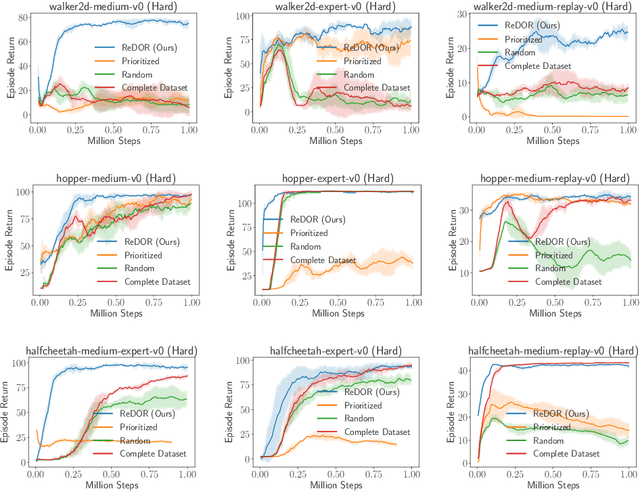
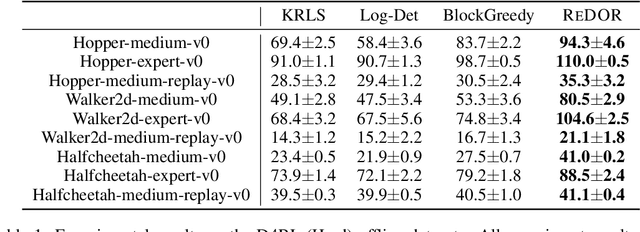

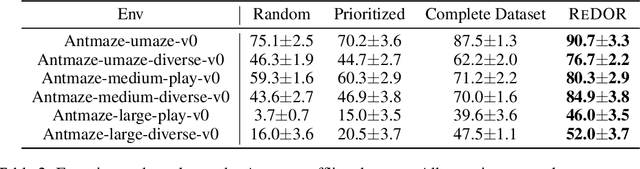
Offline reinforcement learning (RL) represents a significant shift in RL research, allowing agents to learn from pre-collected datasets without further interaction with the environment. A key, yet underexplored, challenge in offline RL is selecting an optimal subset of the offline dataset that enhances both algorithm performance and training efficiency. Reducing dataset size can also reveal the minimal data requirements necessary for solving similar problems. In response to this challenge, we introduce ReDOR (Reduced Datasets for Offline RL), a method that frames dataset selection as a gradient approximation optimization problem. We demonstrate that the widely used actor-critic framework in RL can be reformulated as a submodular optimization objective, enabling efficient subset selection. To achieve this, we adapt orthogonal matching pursuit (OMP), incorporating several novel modifications tailored for offline RL. Our experimental results show that the data subsets identified by ReDOR not only boost algorithm performance but also do so with significantly lower computational complexity.
Episodic Novelty Through Temporal Distance
Jan 26, 2025Exploration in sparse reward environments remains a significant challenge in reinforcement learning, particularly in Contextual Markov Decision Processes (CMDPs), where environments differ across episodes. Existing episodic intrinsic motivation methods for CMDPs primarily rely on count-based approaches, which are ineffective in large state spaces, or on similarity-based methods that lack appropriate metrics for state comparison. To address these shortcomings, we propose Episodic Novelty Through Temporal Distance (ETD), a novel approach that introduces temporal distance as a robust metric for state similarity and intrinsic reward computation. By employing contrastive learning, ETD accurately estimates temporal distances and derives intrinsic rewards based on the novelty of states within the current episode. Extensive experiments on various benchmark tasks demonstrate that ETD significantly outperforms state-of-the-art methods, highlighting its effectiveness in enhancing exploration in sparse reward CMDPs.
S-EPOA: Overcoming the Indivisibility of Annotations with Skill-Driven Preference-Based Reinforcement Learning
Aug 22, 2024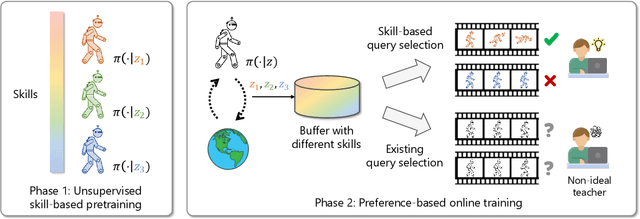
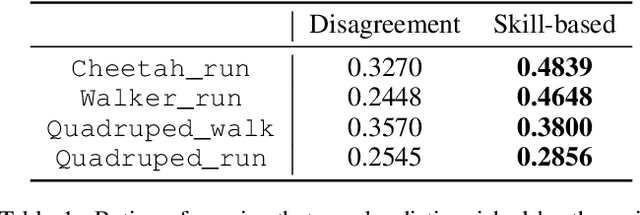
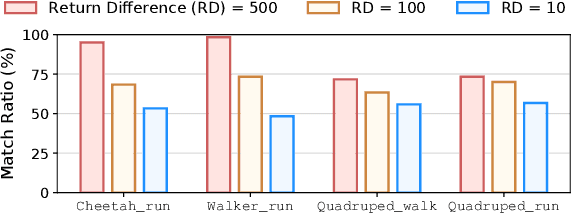
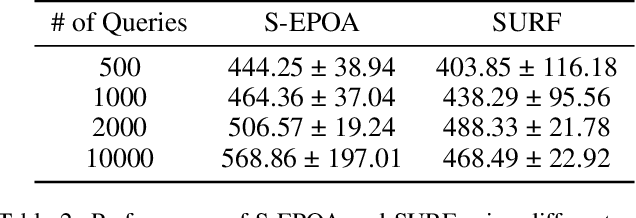
Preference-based reinforcement learning (PbRL) stands out by utilizing human preferences as a direct reward signal, eliminating the need for intricate reward engineering. However, despite its potential, traditional PbRL methods are often constrained by the indivisibility of annotations, which impedes the learning process. In this paper, we introduce a groundbreaking approach, Skill-Enhanced Preference Optimization Algorithm~(S-EPOA), which addresses the annotation indivisibility issue by integrating skill mechanisms into the preference learning framework. Specifically, we first conduct the unsupervised pretraining to learn useful skills. Then, we propose a novel query selection mechanism to balance the information gain and discriminability over the learned skill space. Experimental results on a range of tasks, including robotic manipulation and locomotion, demonstrate that S-EPOA significantly outperforms conventional PbRL methods in terms of both robustness and learning efficiency. The results highlight the effectiveness of skill-driven learning in overcoming the challenges posed by annotation indivisibility.
Bayesian Design Principles for Offline-to-Online Reinforcement Learning
May 31, 2024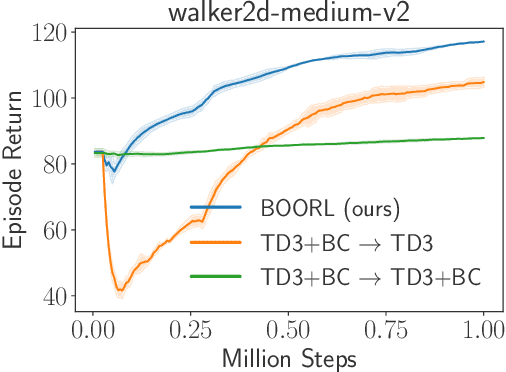
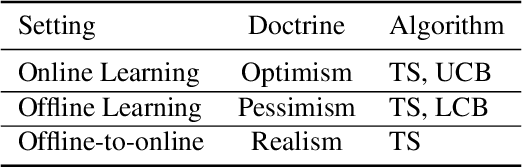

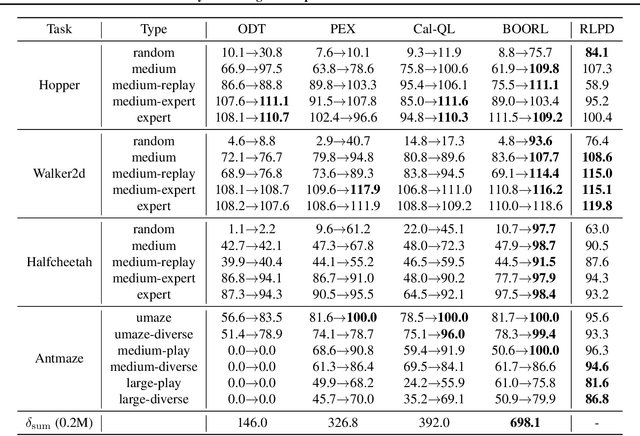
Offline reinforcement learning (RL) is crucial for real-world applications where exploration can be costly or unsafe. However, offline learned policies are often suboptimal, and further online fine-tuning is required. In this paper, we tackle the fundamental dilemma of offline-to-online fine-tuning: if the agent remains pessimistic, it may fail to learn a better policy, while if it becomes optimistic directly, performance may suffer from a sudden drop. We show that Bayesian design principles are crucial in solving such a dilemma. Instead of adopting optimistic or pessimistic policies, the agent should act in a way that matches its belief in optimal policies. Such a probability-matching agent can avoid a sudden performance drop while still being guaranteed to find the optimal policy. Based on our theoretical findings, we introduce a novel algorithm that outperforms existing methods on various benchmarks, demonstrating the efficacy of our approach. Overall, the proposed approach provides a new perspective on offline-to-online RL that has the potential to enable more effective learning from offline data.